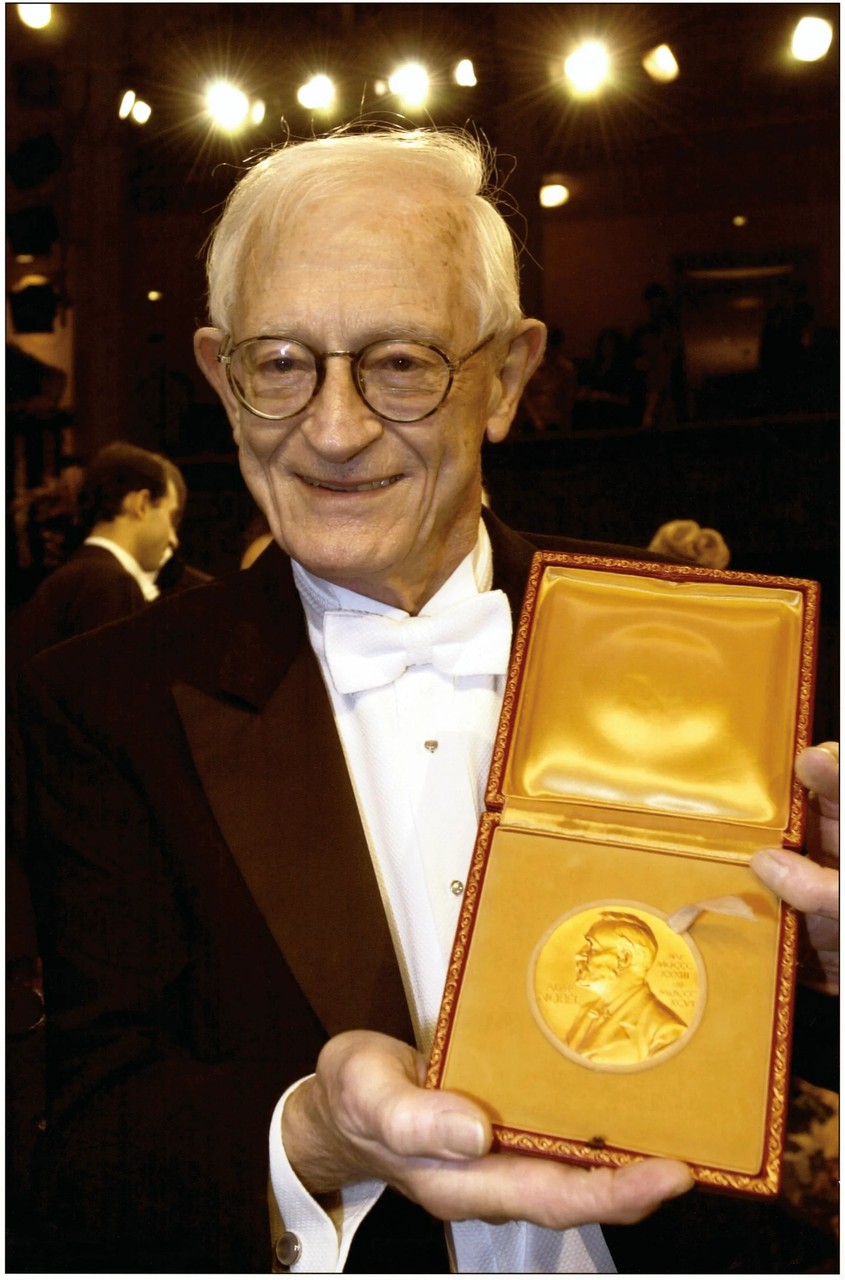
Alan MacDiarmid Has Died
Alan MacDiarmid was born in 1927 in Masterton, New Zealand, into a humble family that felt the full effects of the Great Depression. That childhood—marked by austerity, shared dinners with people even more in need, and weekly baths with recycled water—shaped in him a curious combination: resilience, a deep awareness of the value of money, and a natural talent for human relationships. His fascination with chemistry began almost by chance, when he found one of his father’s old textbooks and, shortly afterwards, a copy of *The Boy Chemist* in the local library. At the age of 16, forced to leave school to work as a laboratory assistant–cleaner at the university, he began part-time higher studies while supporting himself. There he published his first scientific paper, and discovered something that would accompany him for the rest of his life: his love of colour in materials.
MacDiarmid’s academic path was not the typical linear and comfortable ascent. Scholarships and fortuitous opportunities led him first to the University of Wisconsin on a Fulbright scholarship and then to Cambridge, where he married in his college chapel. After brief periods in Scotland, he eventually settled at the University of Pennsylvania, where he spent decades teaching, researching, and training generations of students. His career took a historic turn when he met Alan Heeger and, later, Hideki Shirakawa. Through experimental misunderstandings, overly concentrated catalysts, and the suspicion that certain “impurities” were actually helpful, they discovered how to dope polymers such as polyacetylene to make them conductive. That discovery opened the door to organic electronics and later earned them the Nobel Prize in Chemistry in the year 2000.
Despite half a century away from New Zealand, MacDiarmid never lost touch with his roots: constant phone calls with his siblings, memories of going barefoot at school, and a very clear idea of what he called “the little things”, those everyday gestures that keep the skeleton of relationships alive. He always insisted that success was not about the highest mark, but about knowing one had pushed one’s abilities to their limit. In his Nobel Lecture he recalled that “we are what others have built before us”, and evoked the image of the hunter who spends his life climbing towards the truth, leaving footholds for those who will come after. Alan MacDiarmid, chemist with a love for colour and tireless teacher, understood that science is, at heart, a choral endeavour: no one reaches the summit alone, but all of us can add one more step.
|
Next post: Cetylpyridinium Chloride |
Previous post: Lab Practicals in Germany and Spain |