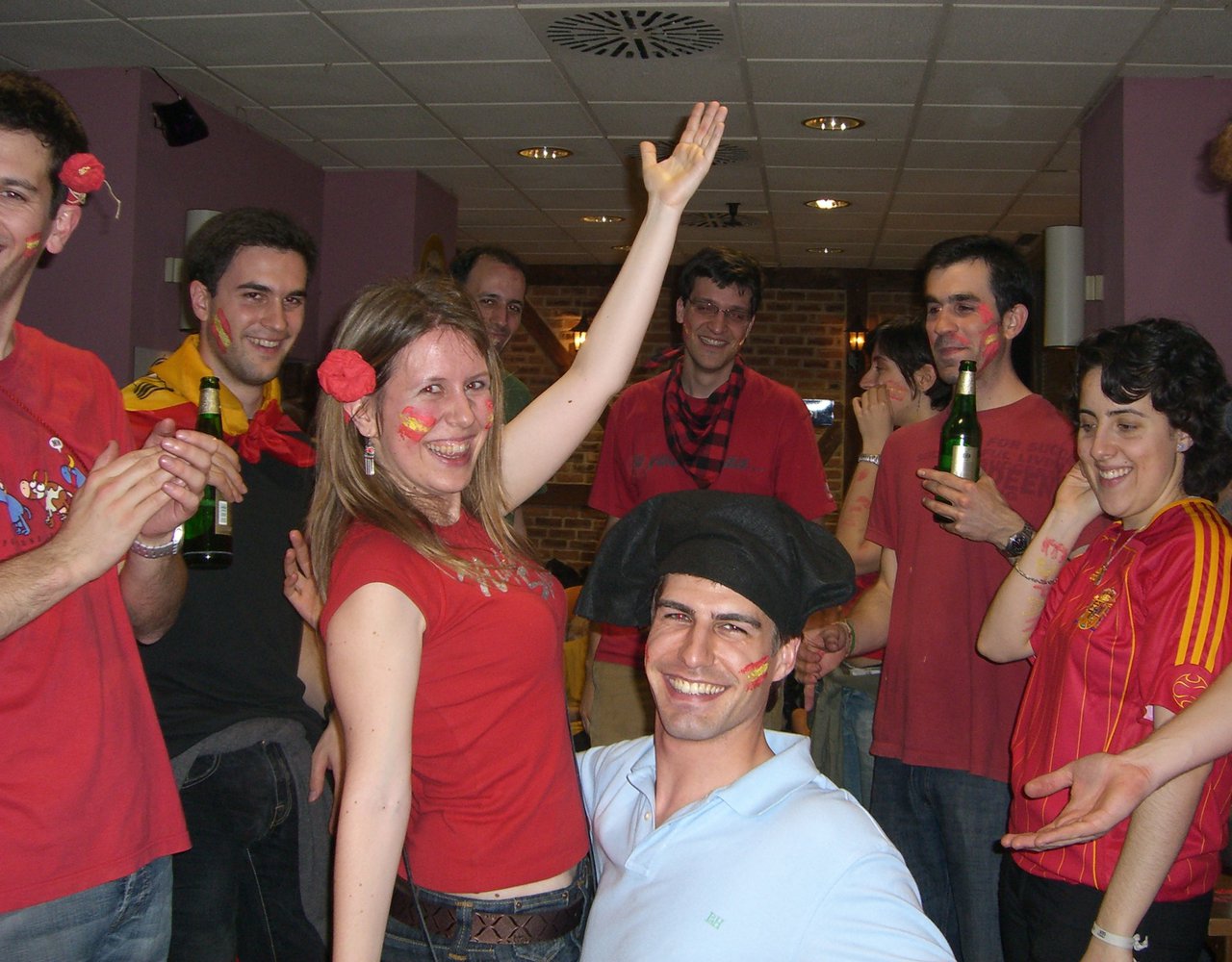
Day 217: Spanischer Abend (Spanish night)
A few months ago, Héctor and I got in touch with the Erasmus iniciative,
a group of volunteer students who organise trips, parties, and other activities for Erasmus scholarship holders from
the university.
We wanted to suggest organising a Spanish-themed party because in the past, at a student club called Gutzcow (run by the
mighty Studentenwerk — the organisation that provides housing and food to students), there had already been cultural nights
about Greece, Poland, France… where you could listen to their music, taste their food, and learn about their customs
(and sometimes their history). Those parties had set the bar pretty high — and now it was Spain’s turn.
Last week I sent an email to the Spanish community in Dresden to start thinking about what food to prepare, how to decorate
the venue… and I also mentioned the delicate topic of how to fund the whole thing, which I assumed would be a hot issue.
But I was wrong. Two days before the party, everyone was enthusiastic, suggesting ideas, and on the day itself, they handed
over the agreed €3 without a single complaint. I sat down at a table in the student canteen and, in less than half an
hour, had collected €100 to buy food, drinks, paint, and “decorative items.” (More money came in later during the party…)
Juan took care of buying finger paints to draw huge Spanish flags on everyone’s faces (or a Catalan senyera… depending
on their level of political involvement).
We formed groups to make Spanish omelettes, ensaladilla rusa (which, despite its name, is Spanish), and pa amb
tomàquet. Others went out to buy drinks and fruit to make sangría and calimocho. A third group crafted
red and yellow bunting out of yellow napkins and a red mattress cover to decorate the club.
Inspired by the ultra-nationalist presentation the Greek group had done before, Héctor and I prepared a PowerPoint about Spain — our history, our food, our celebrations… Although it was a bit cañí and, in my opinion, we focused too much on running of the bulls (Héctor insisted on it), I think it turned out pretty well:
When we arrived at the venue, Barça was still playing. As soon as the match ended, we got to work: we made the sangría, hung up the bunting, and prepared the omelettes (and ate a few bits while we were at it), cutting them up and sticking toothpicks in them.
Pi, pi, piiiiiiiiiii… The referee blew the final whistle at San Siro — and the party at Gutzcow kicked off. The club was packed to the rafters (literally draped in flags… sorry, terrible pun). Students from all over the world had come, along with the usual Germans (German students often come to Erasmus parties to practice their language skills) — and nearly all the Spaniards in town. Everyone had a Spanish flag painted on their face thanks to our tireless makeup team. The music that Cristina, Juan, and friends had put together (a CD/MP3 with over 12 hours of Spanish hits old and new) started blasting.
Right at the start, we projected our presentation. The music we had planned to play during it (“España cañí” and the Allegro
from Isaac Albéniz’s Iberia) didn’t work due to technical issues, but Cristina, Juan & Co.’s soundtrack filled the
gap perfectly — while we were showing a crash course on Spanish history, Nino Bravo’s Libre (covered by El Chaval de la
Peca) was playing. The best part came when the slides showed Spanish cities and monuments: whenever your hometown appeared,
you’d cheer, whistle, and scream like mad.
The presentation ended with two videos: one about the Saca de Soria and another about the running of the bulls in San Fermín.
When it finished, the room erupted in applause. It had been a success. All the foreigners — that is, everyone who
wasn’t Spanish — had fallen in love with Spain. Everyone wanted a copy of the presentation.
Meanwhile, the party went on, and just half an hour in, the 16 family-sized omelettes were gone, the dozens of portions from a whole pot of ensaladilla rusa were gone, Sara’s quesada was gone, the six trays of pa amb tomàquet made by the Catalan team were gone, and of course, the 25 litres of sangría and 30 litres of wine (partly diluted into calimocho) were completely gone too. At one point I went into the kitchen and found a group of Germans scraping the leftover fruit from the giant sangría pots.
The party lasted well into the night with Spanish music blasting, German beers and botas de vino passing from hand to hand nonstop. In fact, it went on until the police, very politely, told us we were being too loud (we were probably barely hitting 60 dB) — but in Germany, silence is sacred.
|
Next post: Day 221: Music for an Unforgettable Night |
Previous post: Day 212: The postman never rings the doorbell |